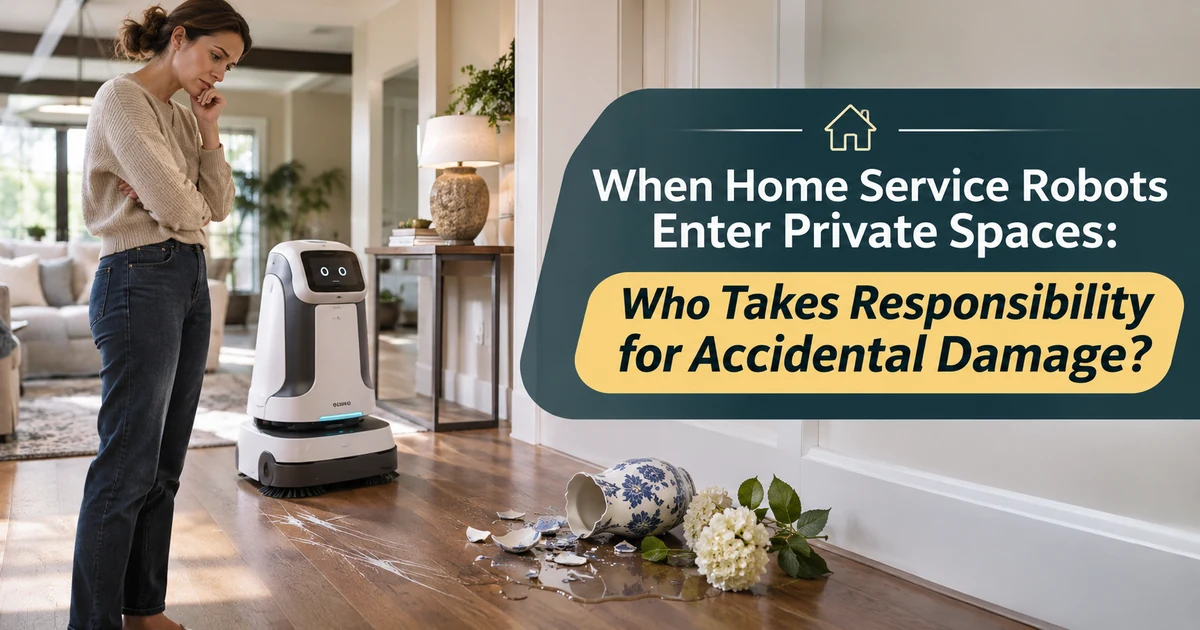
The idea of robots performing household chores once belonged mostly to science fiction. Today, robotic vacuum cleaners, automated lawn mowers, and intelligent cleaning devices are already helping homeowners manage everyday tasks. As artificial intelligence advances, future service robots may take on more complicated responsibilities, including organizing rooms, moving furniture, inspecting equipment, and assisting with home maintenance.
But what happens when a robot accidentally damages something inside a private home?
A cleaning robot might scratch expensive hardwood flooring. An autonomous maintenance machine could damage a plumbing connection. A robotic assistant might knock over valuable furniture while navigating a crowded living room.
Unlike traditional home service visits, these situations introduce questions about responsibility.
Should the homeowner pay because the robot was operating on their property? Should the service company cover the damage? Or should the manufacturer be responsible if faulty software caused the accident?
As robots become more independent, home service robot liability could become an important issue involving property protection, insurance, consumer rights, and accountability.
The challenge is determining who takes responsibility when a machine makes a mistake that no human directly intended.
How Are Home Service Robots Changing Household Maintenance?
Household automation has gradually moved beyond simple programmable appliances.
Traditional robotic vacuum cleaners generally follow cleaning routines using sensors, mapping technology, and navigation software.
More advanced systems may recognize obstacles, adjust their movements, and respond to changing environments.
Robotic lawn mowers already perform certain outdoor maintenance tasks with limited human involvement.
Future home service machines could potentially assist with inspections, cleaning, material handling, and other maintenance activities.
However, these capabilities are not equally mature. General-purpose robots that can safely perform complicated repairs throughout ordinary homes remain an emerging technology.
Private houses present challenges that controlled industrial environments do not.
Furniture moves, pets wander between rooms, and household objects appear in unexpected locations.
A robot must respond to these changing conditions without damaging property or endangering occupants.
This creates a different kind of service relationship, where machines may perform work with less direct human supervision.
What Types of Property Damage Could Household Robots Cause?
Accidental damage could range from minor cosmetic problems to expensive household repairs.
A robot does not need to malfunction completely to cause damage. It may perform its programmed task while misjudging an obstacle, surface, or object.
Potential incidents include:
- Scratched flooring: Cleaning equipment may drag debris or interact improperly with delicate surfaces.
- Damaged furniture: A robot could collide with cabinets, tables, or decorative items.
- Broken personal belongings: Objects may fall when a machine attempts to move or clean around them.
- Water damage: A future robotic maintenance device could accidentally disturb a plumbing connection.
- Wall damage: Navigation errors or mechanical contact could affect painted surfaces and trim.
- Outdoor property damage: Automated equipment might damage landscaping features, edging, or garden fixtures.
The financial consequences depend on what is damaged.
A small scratch on inexpensive furniture is different from water escaping into finished walls or flooring.
For advanced maintenance robots, errors involving electrical, plumbing, or mechanical equipment could create secondary damage.
This makes accident prevention particularly important when robots operate near essential household systems.
Who Is Legally Responsible When a Home Service Robot Causes Damage?
There is no universal rule that automatically makes one party responsible for every robot-related accident.
Liability generally depends on the circumstances, the cause of the damage, applicable laws, and any relevant service agreement.
Several parties could potentially share responsibility.
The manufacturer might face liability if a product defect contributed to the accident.
A service company could be responsible if its employees used the equipment improperly or failed to follow reasonable safety procedures.
The homeowner’s actions may also matter if the robot was operated contrary to clear safety instructions.
A software provider or maintenance contractor could become relevant when an error originates from their work.
However, identifying a possible cause does not automatically establish legal liability.
The affected party may need evidence showing what happened, why the damage occurred, and which legal or contractual duties apply.
Responsibility should depend on the cause of the incident, not simply on the fact that a robot was involved.
Does Liability Change When a Service Company Owns the Robot?
A significant distinction exists between personally owned robots and machines supplied by professional service companies.
When a homeowner purchases a robotic vacuum, they normally operate and maintain the device themselves.
If a household hires a company that brings autonomous equipment to perform cleaning or maintenance, the relationship changes.
The business may control the equipment, determine its operating settings, and decide how the service is performed.
For example, suppose a cleaning company sends a robotic device into a customer’s property.
During operation, the machine damages an expensive cabinet.
The homeowner may reasonably expect the service provider to investigate the incident and explain its process for handling claims.
Whether the company must compensate the customer depends on the agreement, applicable law, and the circumstances.
Businesses using autonomous equipment may therefore need clear policies covering supervision, damage reporting, and insurance.
Could Manufacturers Be Responsible for Faulty AI Decisions?
Manufacturers design the hardware and software that allow robots to operate.
Their responsibilities may become relevant when a defect contributes to an accident.
For example, a faulty obstacle-detection sensor could prevent a robot from recognizing furniture.
A software error might cause unexpected movement or failure to stop when an obstruction appears.
Product liability laws may provide remedies for certain injuries or property damage caused by defective products.
However, these laws differ across jurisdictions, and not every unexpected action proves that a product is legally defective.
The difficult question is whether the robot behaved unreasonably because of a product defect or encountered a situation beyond its intended capabilities.
Manufacturers may increasingly need to explain their systems’ operating limitations, safety mechanisms, and known risks.
What If the Homeowner Gives the Robot Incorrect Instructions?
Robots rely on operating instructions, environmental information, and user settings.
Accidents may occur when equipment is assigned tasks beyond its capabilities.
For example, a homeowner could instruct a lightweight household robot to move furniture that exceeds its approved load capacity.
A cleaning device might be used on flooring that the manufacturer specifically identifies as unsuitable.
A robot could also encounter hazardous conditions because required preparation was ignored.
These circumstances may affect responsibility if the homeowner failed to follow reasonable instructions.
However, manufacturers and service providers cannot necessarily avoid accountability simply by claiming user error.
A proper investigation would need to consider the clarity of warnings, the expected use of the product, and whether the accident could reasonably have been prevented.
What Happens When AI Makes an Unexpected Decision?
Autonomous robots create difficult questions because their behavior may involve decisions that were not individually directed by a human.
A robot might select a route, identify an object, or adjust its movement based on sensor information.
Sometimes, those decisions could produce unintended results.
Consider a robot attempting to move around a chair.
It might incorrectly identify the available space and collide with a nearby display cabinet.
The machine made the immediate navigation decision, but that does not necessarily make it an independent legal party responsible for damages.
Liability would generally still be evaluated through the people and organizations connected to its design, operation, maintenance, or use.
The challenge is reconstructing why the system acted as it did.
Without reliable records, determining whether an incident resulted from a defect, operational error, or environmental condition may become difficult.
Could Software Updates and Remote Operators Complicate Responsibility?
Connected robots may receive software updates that change navigation, object recognition, and operating behavior.
An update could improve safety, but an error might also introduce unexpected problems.
Suppose a robot operates correctly for several months before a software update causes it to misjudge certain obstacles.
If property damage follows, investigators may need to examine the software version and circumstances of the incident.
Remote operation creates another complication.
Some emerging robotic services may allow human operators to assist machines from another location.
If a remote operator directly controls a robot when damage occurs, their actions may become relevant to determining responsibility.
These situations show why robotics liability may involve more than the machine’s physical owner.
Clear operating records and service agreements could become increasingly important.
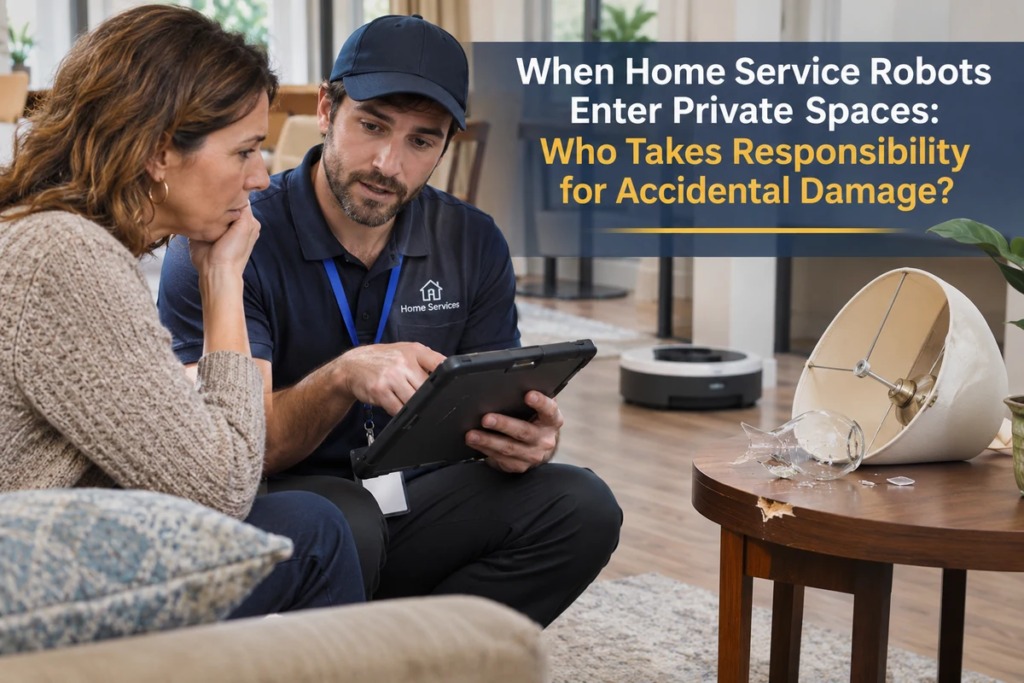
Would Homeowners Insurance Cover Damage Caused by Robots?
Insurance coverage is likely to become an important consideration as home robotics expands.
However, homeowners should not assume every robot-related accident is automatically covered.
A homeowners policy may cover certain accidental property losses, subject to its terms, exclusions, and deductibles.
Coverage can also differ depending on whether the damaged property belongs to the homeowner or another person.
If a professional service company operates the robot, its business liability insurance may be relevant.
Manufacturer responsibility may also need separate consideration if a defective product caused the loss.
The appropriate insurance response depends on the specific incident and policy wording.
Before allowing advanced robotic equipment to perform work, homeowners may want to ask whether the provider carries suitable liability coverage.
For expensive or high-risk services, written confirmation of applicable insurance can help avoid confusion after an accident.
How Could Homeowners Prove That a Robot Caused the Damage?
Determining responsibility requires evidence.
Traditional service disputes may rely on photographs, witness statements, and technician reports.
Robotic incidents could produce additional digital records.
Depending on the device, these might include movement logs, sensor readings, operating timestamps, software versions, or recorded error messages.
Some robots may also create visual records of their surroundings.
These details could help establish what happened before an incident.
However, not every robot records sufficient information to reconstruct an accident accurately.
Data may be incomplete, overwritten, or stored in systems controlled by the provider.
Homeowners should document damage promptly and request preservation of relevant records.
A reliable claims process should not depend entirely on information that only one party can access or interpret.
What Should Homeowners Do Immediately After a Robot Causes Damage?
The appropriate response depends on the severity of the incident.
If a robot damages furniture or household belongings, homeowners should stop the activity and document the affected area.
For more serious incidents involving water, electricity, or possible injury, safety comes first.
Homeowners should avoid approaching hazardous equipment or attempting repairs beyond their knowledge.
Useful steps may include:
- Stop the robot safely. Use its normal emergency stop or shutdown function if it is safe to do so.
- Document the damage. Take photographs and record the time and surrounding circumstances.
- Preserve available records. Avoid unnecessarily deleting software logs or incident notifications.
- Notify the responsible provider. Contact the service company, manufacturer, or operator as appropriate.
- Review insurance arrangements. Ask the relevant insurer about coverage and reporting requirements.
- Obtain professional assessment. Significant plumbing, electrical, or structural damage may require qualified inspection.
Homeowners should avoid making permanent repairs before necessary documentation, unless immediate action is required to prevent further harm.
Could Home Service Robots Threaten Privacy as Well as Property?
Physical damage is not the only concern when autonomous equipment enters private homes.
Robots may rely on cameras, microphones, mapping systems, and other sensors to understand their surroundings.
These technologies could capture sensitive household information.
A robot moving through bedrooms, offices, or living spaces might encounter documents, personal belongings, or private conversations.
If information is transmitted to remote servers or human operators, residents may have questions about who can access it.
Future service agreements may need to address whether recordings are retained, how long data is stored, and whether operators can view private spaces.
Privacy concerns become especially important when residents are not the individuals who purchased or authorized the robot.
Family members, visitors, and tenants may also be affected.
Responsible robotic services should explain their data practices clearly and provide meaningful privacy controls.
Should Robot Service Contracts Include Damage Protection?
As commercial home robotics develops, service agreements may need more specific provisions.
Traditional contracts already address service scope, payment, cancellations, and certain liability matters.
Robotic services could require additional clarity.
Homeowners may want written answers about:
- Who owns and operates the robot
- Whether human supervision is provided
- What happens when equipment damages property
- Which insurance policies may apply
- How incidents are reported and investigated
- Whether operating records are preserved
- What information is collected inside the home
- How disputes and compensation requests are handled
Contract terms cannot necessarily eliminate legal obligations established by consumer protection or product liability laws.
Nevertheless, clear agreements can reduce misunderstandings.
They also help homeowners understand whether they are purchasing equipment, renting a robot, or hiring a company to perform a service using autonomous technology.
Could Robots Make Home Maintenance Safer Despite These Risks?
Robotic equipment also offers potential safety benefits.
Machines may eventually assist with tasks that expose human workers to difficult conditions.
For example, specialized robots could inspect confined areas, assess selected building conditions, or support work in environments where direct access creates hazards.
Automation may also reduce certain repetitive tasks and improve monitoring consistency.
However, these benefits do not remove the need for risk assessment.
A robot that reduces one hazard could introduce another through unexpected movement, software failure, or improper operation.
Safety depends on equipment design, appropriate task selection, and reliable supervision.
The objective should be to use robots where they provide meaningful advantages without creating unacceptable risks for occupants or property.
Could Robot Liability Change the Future of Home Service Businesses?
As service companies adopt more autonomous equipment, accountability could become an important factor in customer trust.
Homeowners may increasingly ask how businesses supervise robotic machines and respond when something goes wrong.
Companies could develop procedures for inspecting equipment before use, documenting operating conditions, and preserving incident records.
Insurance arrangements may also evolve to address the combination of mechanical equipment, software decisions, and human supervision.
However, robotic equipment should not become an excuse for unclear responsibility.
Customers still need dependable services, reasonable safety precautions, and a practical way to resolve accidental damage.
Businesses that introduce automation may need to demonstrate that their service quality and accountability remain consistent.
People Also Ask About Home Service Robot Liability
Who pays if a robot damages something inside my home?
Responsibility depends on what caused the damage, who controlled the robot, applicable laws, and relevant contracts. A manufacturer, service provider, or operator could potentially be responsible. Insurance coverage may also apply, depending on the circumstances and policy terms.
Can homeowners sue a robot manufacturer for property damage?
Homeowners may have legal options when a defective product causes property damage. However, a successful claim generally requires satisfying applicable legal requirements, including evidence of the defect and its connection to the damage. Rules differ between jurisdictions.
Is a cleaning company responsible if its robot breaks furniture?
A cleaning company may be responsible if the damage resulted from its negligence, breach of contract, or another legally recognized basis. The outcome depends on the service agreement, applicable law, and circumstances. Homeowners should document the incident and request the company’s claims procedure.
Does homeowners insurance cover damage from robotic equipment?
Some accidental damage may fall within homeowners insurance coverage, but policies contain conditions and exclusions. Coverage may depend on the damaged property, cause of loss, and whether a third-party provider was involved. The insurer must evaluate the specific policy and circumstances.
Who is liable if a robot makes a decision without human control?
Autonomous decision-making does not automatically remove legal responsibility from the people or companies connected to the machine. Investigations may examine manufacturing defects, software problems, inadequate supervision, or improper operation to determine which parties may be liable.
Can robotic service companies record inside private homes?
Some robots use cameras and other sensors for navigation or remote assistance. Whether recordings are stored, accessed, or shared depends on the system and provider. Companies must comply with applicable privacy requirements, and residents should review recording policies before allowing access.
What evidence should homeowners collect after robotic property damage?
Photographs, incident timestamps, service agreements, correspondence, repair estimates, and available robot operating records may help document the event. Homeowners should request that relevant digital logs be preserved and avoid altering potentially important evidence.
Should homeowners allow robots to perform repairs without supervision?
Appropriate supervision depends on the task, equipment capabilities, and manufacturer’s operating requirements. High-risk activities involving electricity, plumbing, structural components, or heavy objects may require specialized safeguards and qualified professionals. Homeowners should not assume that automation eliminates the need for oversight.
Who Should Be Accountable When Machines Enter Our Homes?
The growing role of robotics in household maintenance could change how people arrange services and manage their properties.
Machines may eventually take responsibility for increasingly complicated tasks, from cleaning and organization to inspections and maintenance assistance.
These technologies could improve convenience and help service professionals work more efficiently.
However, greater autonomy also creates questions about responsibility when something goes wrong.
A damaged floor, broken appliance, or accidental plumbing problem should not become impossible to resolve simply because a machine performed the work.
Manufacturers, service companies, software providers, and equipment operators may each have responsibilities depending on their involvement and the cause of an incident.
Homeowners will also need to understand operating limitations, privacy implications, and insurance arrangements before introducing autonomous equipment into private spaces.
The future of home robotics will depend not only on how intelligently machines perform tasks but also on how reliably the organizations behind them respond to mistakes.
Because when robots begin working inside our homes, true technological progress will mean more than completing chores automatically. It will also mean knowing who takes responsibility when automation causes harm.
Leave a Reply