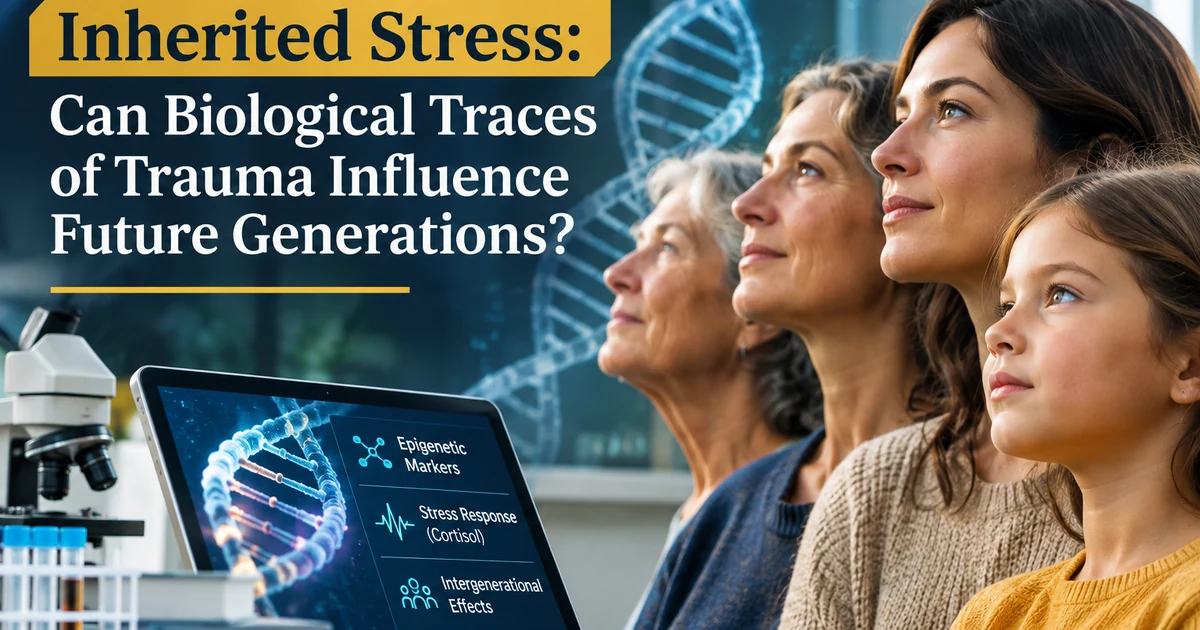
Trauma is often understood as something experienced by an individual. A difficult childhood, a devastating loss, exposure to violence, or prolonged hardship can leave lasting psychological and physical effects. But what if some consequences of these experiences extend beyond the person who lived through them?
Researchers are investigating whether severe stress can influence biological processes that may affect future generations.
Studies in epigenetics, neuroscience, and developmental biology suggest that stressful experiences can be associated with changes in how genes are regulated and how the body responds to threats.
Some research has also identified biological differences in children whose parents experienced significant trauma.
However, scientists have not established that traumatic experiences are routinely transmitted through inherited epigenetic changes in humans.
This raises an intriguing question: Could future generations carry biological traces of experiences they never personally lived through?
The possibility of inherited stress challenges traditional ideas about genetics, emotional health, and the relationship between personal experiences and biological inheritance.
Understanding this emerging science requires examining what researchers have discovered, what remains uncertain, and why inherited vulnerability does not necessarily determine someone’s future.
What Is Inherited Stress?
Inherited stress is a broad, informal term describing the possibility that the consequences of stress or trauma experienced by one generation can influence later generations.
Researchers more commonly use terms such as intergenerational trauma, transgenerational effects, and intergenerational transmission of stress.
These concepts are related but do not always describe the same biological process.
Intergenerational trauma involves effects observed in the children of people who experienced significant adversity.
These effects may arise through family environments, caregiving relationships, economic circumstances, prenatal exposures, or possible biological pathways.
Transgenerational biological inheritance describes a narrower possibility: effects transmitted to later generations that were not directly exposed to the original conditions.
The distinction matters because children can be affected by their parents’ experiences without inheriting a biological record of those experiences.
Inherited stress should not be understood as proof that trauma is permanently encoded into someone’s DNA.
Can Trauma Leave Biological Traces in the Body?
Stress activates biological systems that help the body respond to potentially threatening situations.
During stressful experiences, the nervous system and hormonal pathways coordinate changes in alertness, energy availability, and physical readiness.
These responses are useful when dealing with immediate challenges.
However, severe or prolonged stress can be associated with changes in physiological regulation.
Researchers have examined relationships between traumatic experiences and several biological processes, including:
- Stress hormone regulation: Changes involving cortisol and related signaling pathways.
- Inflammatory activity: Associations between chronic adversity and immune system responses.
- Sleep regulation: Changes in sleep quality and patterns of physiological recovery.
- Autonomic nervous system activity: Differences in how the body responds to perceived threats.
- Epigenetic regulation: Changes in molecular mechanisms that influence gene activity.
These findings do not mean trauma leaves one universal biological signature.
Different individuals respond differently, and many observed changes are influenced by health, environment, and personal circumstances.
How Does Stress Change the Brain and Nervous System?
The human stress response involves several interconnected brain regions and hormonal systems.
One important pathway is the hypothalamic-pituitary-adrenal axis, commonly called the HPA axis.
This system helps regulate cortisol and coordinate the body’s response to stressful situations.
When a person experiences adversity, the stress response may become more active.
After the situation passes, regulatory mechanisms normally help the body return toward its usual state.
Prolonged or repeated adversity can sometimes be associated with changes in this regulation.
Researchers have observed differences in stress-related physiology among some individuals exposed to significant trauma.
However, there is no single cortisol pattern that proves someone has experienced trauma.
Stress responses vary with age, health conditions, sleep, medication, and the nature of the experience.
These biological differences provide clues about how adversity affects health, but they do not automatically establish inherited effects.
What Does Epigenetics Have to Do With Inherited Trauma?
Epigenetics examines mechanisms that influence gene activity without necessarily changing the underlying DNA sequence.
DNA contains genetic instructions, but cells do not use every gene in the same way.
Epigenetic mechanisms help regulate when and how particular genes are expressed.
One widely studied process is DNA methylation, which involves chemical modifications associated with gene regulation.
Environmental conditions, development, aging, and other biological processes can influence epigenetic patterns.
Researchers have investigated whether exposure to severe stress is associated with changes in methylation near genes involved in stress regulation.
Some studies have identified such associations in people who experienced trauma and in their children.
However, identifying similar epigenetic differences across generations does not prove that the changes were directly inherited.
Shared genetics, prenatal conditions, family environments, and other exposures may also contribute.
The challenge is separating these explanations.
Does Trauma Actually Change Your DNA?
Traumatic experiences do not normally rewrite a person’s genetic sequence into a new set of inherited instructions.
This is an important distinction between genetics and epigenetics.
Genetic changes involve alterations to the DNA sequence itself.
Epigenetic changes involve mechanisms that influence how genetic information is regulated.
Some epigenetic modifications may change over time, while others can persist within particular cells.
However, persistence within an individual does not automatically mean a modification can pass to future generations.
During reproduction and early development, extensive epigenetic reprogramming occurs.
Many existing epigenetic patterns are reset.
Researchers are studying whether some environmentally influenced signals can escape this process and affect descendants.
The possibility has received meaningful support from certain animal experiments, but evidence of stable trauma-related epigenetic inheritance in humans remains limited.
What Is the Difference Between Intergenerational and Transgenerational Trauma?
The distinction becomes especially important when examining pregnancy.
Imagine a pregnant individual experiencing severe adversity.
The pregnant person is directly exposed to the stressful conditions.
The developing fetus may also experience changes in the prenatal environment.
Additionally, the reproductive cells developing within that fetus may be exposed during the same pregnancy.
This means biological effects observed in multiple generations do not automatically establish transmission without direct exposure.
In certain research definitions, demonstrating true transgenerational inheritance after a pregnant individual’s exposure may require studying later descendants beyond those directly exposed.
Paternal exposure before conception presents a different biological arrangement.
Researchers must consider whether reproductive cells were directly affected and whether any effects persist in generations not exposed to the original conditions.
These distinctions make human transgenerational research particularly challenging.
What Have Scientists Discovered About Trauma Across Generations?
Researchers have examined families affected by war, displacement, severe adversity, and other traumatic experiences.
Some studies have found associations between parental trauma and differences in offspring stress physiology or epigenetic measurements.
Research involving descendants of Holocaust survivors has contributed to scientific interest in these questions.
Other investigations have examined families affected by early-life adversity and difficult prenatal environments.
Findings suggest that parental experiences may be associated with biological differences in children.
However, many studies involve relatively small samples or observational designs.
Researchers cannot always separate possible biological transmission from shared environments and family experiences.
Some findings also differ between studies.
The evidence supports further investigation, but it does not establish that trauma is consistently inherited through epigenetic mechanisms across human generations.
Why Are Animal Studies Important to This Research?
Animal experiments allow scientists to investigate biological mechanisms under more controlled conditions.
Researchers can examine how stressful experiences affect reproductive cells, offspring development, and behavior.
Some experiments involving rodents have reported changes in offspring physiology or stress-related behavior after parental exposure to certain stressors.
Other studies have investigated whether small RNA molecules in sperm could contribute to these effects.
Such findings suggest possible pathways through which parental experiences might influence offspring biology.
However, animal results cannot automatically be applied to humans.
Species differ in reproduction, development, behavior, and environmental complexity.
Human trauma also involves social relationships, personal meaning, and historical circumstances that laboratory models cannot fully reproduce.
Animal studies provide mechanistic clues rather than definitive proof of inherited human trauma.
Could Stress During Pregnancy Affect a Child’s Development?
Pregnancy is an important period for fetal growth and development.
Maternal health, nutrition, medical conditions, environmental exposures, and severe stress can influence prenatal conditions.
Researchers have examined whether significant maternal adversity is associated with differences in child development and stress-related biology.
Some studies have identified relationships between prenatal stress and later developmental outcomes.
However, associations do not necessarily establish that stress alone caused those outcomes.
Pregnancy involves numerous interacting factors, and individual responses vary.
Importantly, ordinary stress during pregnancy should not be interpreted as causing inevitable harm.
Nor should parents be blamed for experiencing difficult circumstances beyond their control.
Supportive healthcare, appropriate mental health services, and social support remain important during pregnancy.
Prenatal influences are also distinct from inherited epigenetic changes passed through reproductive cells.
Could a Father’s Trauma Influence Future Children?
Researchers are also investigating whether paternal experiences before conception might influence offspring.
Some animal studies suggest that environmental exposures can affect molecular signals carried by sperm.
These findings have encouraged research into whether severe stress could influence reproductive biology.
However, the evidence supporting trauma-related epigenetic inheritance through human sperm remains preliminary.
Human studies face difficulties accounting for genetics, health behaviors, relationships, and shared environments.
A father’s previous trauma may also affect family life through pathways unrelated to reproductive cells.
For example, unresolved distress may influence sleep, emotional regulation, or communication within the household.
These possibilities should not be confused with proof of biological inheritance.
Paternal experiences matter, but the mechanisms connecting those experiences with child outcomes require careful investigation.
Can Family Behavior Pass Stress Between Generations?
Not every intergenerational effect requires an inherited biological mechanism.
Children learn about the world partly through relationships with caregivers.
They may observe how adults respond to uncertainty, conflict, and perceived danger.
A parent who has experienced severe trauma may sometimes respond more cautiously to situations associated with past threats.
Children could learn similar responses through everyday interactions.
However, trauma does not automatically prevent someone from becoming a supportive and attentive parent.
Many survivors develop strong coping strategies and create stable environments for their families.
Intergenerational patterns can also be influenced by financial hardship, discrimination, displacement, and continuing exposure to stressful conditions.
These influences demonstrate why inherited stress must be understood through both biological and social perspectives.
Can Someone Experience Trauma-Related Effects Without Knowing Their Family History?
A person may experience anxiety, stress sensitivity, or other difficulties without knowing much about earlier generations.
However, these experiences do not prove the presence of inherited trauma.
Many biological, psychological, and environmental factors can contribute to emotional distress.
Current science does not provide a validated clinical test that can determine whether an individual’s symptoms originated from an ancestor’s traumatic experience.
Family history may sometimes provide useful context.
For example, understanding patterns of displacement, instability, or difficult relationships could help explain certain family experiences.
Nevertheless, explanations should not be forced onto individuals.
Someone does not need to discover hidden ancestral trauma to understand or address their current mental health.
Could Trauma Influence Three or More Generations?
Historical events can affect families and communities for decades.
War, displacement, poverty, and institutional discrimination may create consequences that persist long after the original event.
These effects can involve economic opportunities, social relationships, access to healthcare, and family stability.
Biological researchers are investigating whether additional mechanisms might contribute.
However, observing similar difficulties across three generations does not prove that a biological mark was inherited.
The same underlying social conditions may continue affecting descendants.
Researchers must also account for direct prenatal exposures and shared genetic characteristics.
Demonstrating true transgenerational biological inheritance requires evidence that the effects persist through a relevant biological pathway without being explained by these other factors.
That standard has not yet been conclusively met for human trauma.
Does Inherited Stress Mean Future Generations Are Destined to Suffer?
No. Biological vulnerability is not the same as destiny.
Even when certain family experiences are associated with increased risk, they do not determine an individual’s emotional health.
People differ in their biological responses, relationships, environments, and access to support.
A family history involving trauma does not mean every descendant will experience anxiety, depression, or other conditions.
Epigenetic processes are also dynamic rather than universally permanent.
Most importantly, individuals can develop supportive relationships, effective coping skills, and healthier living conditions.
Research into intergenerational adversity should never imply that survivors permanently damage their descendants.
Such interpretations oversimplify the science and may unfairly stigmatize families who have already experienced significant hardship.
Could Therapy and Support Interrupt Intergenerational Stress?
Psychological care and supportive environments can help individuals manage trauma-related difficulties.
Evidence-based approaches for trauma-related conditions may improve symptoms, emotional regulation, and daily functioning.
Family-focused interventions can also strengthen communication and caregiver-child relationships.
For children, consistent support and stable environments may provide important developmental benefits.
These improvements do not require proving that someone carries an inherited epigenetic mark.
Researchers are investigating whether psychological interventions may also be associated with changes in biological stress markers.
However, there is no established treatment specifically designed to erase inherited trauma from human DNA.
The practical goal is improving health and relationships rather than attempting to remove a scientifically unconfirmed ancestral imprint.
Could Future Medicine Identify Biological Traces of Trauma?
Advances in epigenetic research may eventually help scientists understand why individuals respond differently to severe adversity.
Researchers are studying combinations of genetic, epigenetic, physiological, and environmental information.
Future tools might improve assessments of stress-related vulnerability or treatment responses.
However, identifying reliable biomarkers presents significant challenges.
Epigenetic patterns vary between tissues, across time, and in response to numerous influences.
A blood or saliva sample cannot currently reveal a person’s ancestral trauma history with clinical reliability.
Furthermore, a biological association does not necessarily establish the origin of a psychological condition.
Future medical applications will need strong evidence demonstrating accuracy, clinical usefulness, and appropriate interpretation.
Could Ancestral Trauma Research Create Privacy Concerns?
Research involving inherited stress raises sensitive questions about biological identity.
If future tests could identify certain stress-related vulnerabilities, individuals might worry about how those results could be used.
Potential concerns include access by employers, insurers, or commercial health platforms.
There is also a risk of labeling entire families or communities as biologically damaged because of historical experiences.
Such conclusions would be scientifically inappropriate and socially harmful.
Researchers must distinguish group-level associations from predictions about individuals.
Privacy protections, informed consent, and responsible communication will be essential as the field develops.
Understanding the biological consequences of adversity should support better healthcare, not create new forms of discrimination.
People Also Ask About Inherited Stress and Generational Trauma
Can trauma really be passed down through DNA?
There is no conclusive evidence that traumatic experiences are routinely passed through changes to the human DNA sequence. Researchers are investigating whether stress-related epigenetic signals can influence descendants. Human findings remain preliminary, and family environment, genetics, and prenatal exposures may also explain observed associations.
Can you inherit anxiety from your parents’ trauma?
Children of trauma-exposed parents may experience increased vulnerability to certain emotional difficulties, but this does not mean anxiety is directly inherited from trauma. Genetic predispositions, caregiving experiences, environmental conditions, and individual circumstances can all contribute. No single mechanism explains every family’s experience.
Can grandparents’ trauma affect grandchildren?
Grandparents’ experiences can influence later generations through family relationships, economic circumstances, cultural experiences, and continuing environmental conditions. Researchers are also investigating possible biological mechanisms. However, direct epigenetic inheritance of trauma across unexposed human generations has not been conclusively demonstrated.
What are the biological signs of inherited trauma?
There is no validated set of biological signs that proves someone has inherited trauma. Researchers study cortisol regulation, DNA methylation, and other stress-related measurements, but these markers are influenced by many factors. They cannot independently establish whether a person’s ancestors experienced trauma.
Can inherited trauma affect the nervous system?
Parental adversity may be associated with differences in offspring stress regulation, but the mechanisms are complex. Prenatal conditions, family environments, genetics, and possibly epigenetic processes may contribute. Such differences are not inevitable and do not necessarily indicate a disorder.
Is inherited trauma permanent?
There is no evidence that every descendant of a trauma survivor carries permanent biological damage. Stress-related physiological and epigenetic patterns can vary, and many biological processes remain responsive to environmental conditions. Supportive relationships and appropriate healthcare can improve well-being regardless of family history.
Can therapy help with intergenerational trauma?
Yes. Therapy can help people address trauma-related symptoms, understand family patterns, and develop healthier coping strategies. Family-based support may also improve communication and relationships. However, therapy should not be described as a proven method for removing inherited epigenetic trauma markers.
Is generational trauma scientifically proven?
Intergenerational effects of trauma are supported by research involving psychological, social, developmental, and biological outcomes. However, the specific claim that trauma is directly inherited through stable epigenetic changes across unexposed human generations remains scientifically uncertain.
Could Future Generations Carry More Than Genetic Information?
Human inheritance involves far more than the DNA sequences passed from parents to children.
Families also transmit experiences, relationships, resources, cultural knowledge, and ways of responding to the world.
Research into stress biology and epigenetics is expanding scientific understanding of how environmental experiences may influence development and health.
Some findings suggest that parental adversity can be associated with biological differences in offspring.
Yet scientists are still investigating whether those differences reflect direct biological inheritance, shared environments, prenatal influences, or interactions between several mechanisms.
The possibility of inherited stress should therefore be approached with scientific curiosity rather than certainty.
Most importantly, family history does not determine a person’s future.
Even when earlier generations experienced profound hardship, descendants can develop resilience, form supportive relationships, and create healthier environments.
Because understanding how trauma may influence future generations is not about proving that suffering becomes permanent. It is about discovering how the effects of adversity develop, how they can be reduced, and how future generations can experience healthier lives.
Leave a Reply