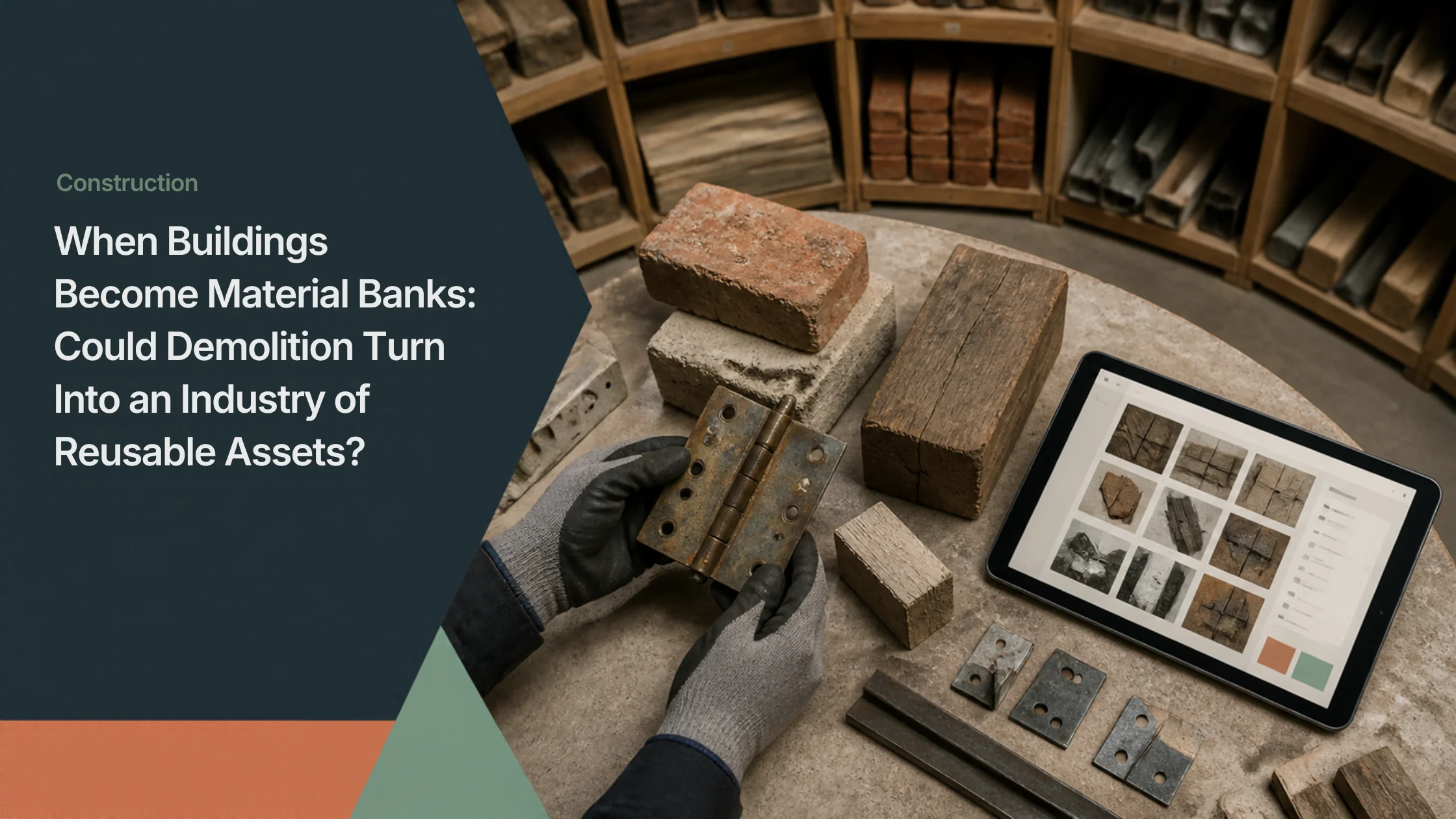
Every building contains more than walls, floors, windows, and structural supports. Hidden within its construction are valuable materials that required energy, labor, and natural resources to produce.
Yet when buildings reach the end of their useful lives, many of these materials are treated as waste.
Steel beams are removed, concrete is crushed, wooden structures are dismantled, and usable fixtures may disappear into mixed demolition debris. Materials that once supported an entire building can quickly lose their practical value.
But what if buildings were treated as storage facilities for valuable construction resources rather than structures destined for disposal?
This idea is gaining attention through an approach known as buildings as material banks.
Instead of viewing demolition as the final stage of a building’s life, architects, engineers, and material recovery specialists are exploring ways to recover components for future construction projects.
A steel beam from an old office could support a new building. Wooden flooring might find another home, while doors, windows, and architectural features could enter specialized resale markets.
This raises an important question: Could demolition eventually become an industry focused on recovering valuable assets rather than simply clearing land?
The answer may depend on how buildings are designed, documented, dismantled, and valued.
What Does It Mean When Buildings Become Material Banks?
The concept of buildings as material banks treats structures as temporary collections of valuable resources.
Instead of assuming construction materials will become waste when a building is removed, the approach considers their potential for future use.
A building may contain steel, timber, glass, bricks, and mechanical equipment that retain value long after the structure no longer serves its original purpose.
These components can potentially be recovered, inspected, refurbished, and incorporated into other projects.
The concept connects directly to the circular economy, which aims to keep materials in productive use for as long as practical.
An earlier European research initiative called Buildings as Material Banks explored material passports and reversible construction methods to support this approach.
Its central idea was that buildings could preserve the value of their materials rather than becoming sources of disposal costs.
Why Is Traditional Demolition Being Reconsidered?
Conventional demolition prioritizes removing a structure efficiently and preparing the site for its next use.
Heavy machinery can break down buildings relatively quickly, but the process may damage materials that could otherwise be reused.
Mixed demolition debris can also be difficult to separate into products suitable for direct reuse.
Construction and demolition waste represents a substantial resource-management challenge.
Discarding usable components can mean losing the materials, energy, and manufacturing effort already invested in their production.
Recovering selected materials offers a different approach.
Instead of purchasing entirely new products for every project, builders could potentially reuse components from structures that are being removed.
However, recovering materials is not always practical.
Some buildings contain damaged components, hazardous substances, or construction systems that cannot be separated economically.
The opportunity lies in determining which materials have sufficient remaining value to justify careful recovery.
How Is Deconstruction Different From Demolition?
Deconstruction involves systematically dismantling a building to recover materials for reuse.
Traditional demolition generally focuses on removing the structure, with recycling or salvage incorporated where practical.
Deconstruction places greater emphasis on preserving individual components.
For example, workers might carefully remove doors, flooring, fixtures, and reusable timber before dismantling the remaining structure.
A partially deconstructed building may still require conventional demolition for components that cannot be safely recovered.
The process can involve additional labor, planning, storage, and inspection.
However, it may also create opportunities to recover products with meaningful resale value.
The difference is primarily one of priorities.
Traditional demolition asks how a building can be removed efficiently.
Deconstruction asks how much useful value can be preserved while the building is removed safely.
Which Building Materials Could Become Valuable Reusable Assets?
Not every construction material has equal potential for recovery.
Some products are relatively easy to remove and reinstall, while others are permanently bonded into structural systems.
- Structural steel: Beams and columns may be reusable after suitable inspection, testing, and preparation.
- Timber: Certain framing members, large beams, and hardwood flooring can retain commercial value.
- Bricks: Individual bricks may be recovered where their condition and original mortar allow practical separation.
- Doors and windows: Selected components can be reused when they satisfy relevant performance and installation requirements.
- Architectural stone: Durable stone products may be suitable for additional applications.
- Interior fixtures: Cabinets, lighting, and certain plumbing fixtures may have resale potential.
- Mechanical equipment: Some equipment can be refurbished, subject to condition, efficiency, safety, and compatibility.
The usefulness of these materials depends on their original design, remaining condition, and the requirements of the next project.
A component’s age alone does not determine whether it can be reused.
Could Structural Steel Become a Major Asset in Building Recovery?
Structural steel is one of the more promising materials for direct reuse.
Steel beams and columns can retain useful mechanical properties when properly maintained and recovered without significant damage.
Unlike recycling steel through melting, direct reuse may avoid substantial processing.
However, recovered structural steel must be evaluated before becoming part of another building.
Engineers need reliable information about its dimensions, condition, strength, and previous use.
Inspection and testing may be necessary when original documentation is unavailable.
Specialized guidance already exists for assessing reclaimed structural steel.
The challenge involves creating reliable recovery and certification processes that allow reused components to meet applicable construction requirements.
A beam that once supported an office building could potentially serve another structure, but its new application must be independently verified.
What Happens to Concrete When Buildings Are Dismantled?
Concrete presents a different challenge because it is often difficult to separate into reusable structural components.
Conventional reinforced concrete can be broken into smaller pieces and processed as recycled aggregate.
These materials may be suitable for selected applications, depending on their quality and relevant specifications.
However, crushing concrete into aggregate is recycling rather than direct reuse of an intact component.
Some prefabricated concrete elements may offer greater reuse potential if their connections and condition allow safe removal.
Future building designs could make precast elements easier to recover and reinstall.
Direct reuse may preserve more of the original component’s manufactured value, but it requires careful planning.
The construction method used today can therefore determine whether tomorrow’s demolition produces reusable components or primarily crushed material.
How Could Material Passports Change the Value of Buildings?
A material passport is a record containing information about the materials and components used in a building.
It may document product characteristics, locations, dimensions, composition, maintenance requirements, and potential reuse options.
Imagine a building owner preparing to remove a commercial property.
Instead of relying entirely on visual inspections, contractors could examine digital records identifying important materials.
The information might reveal where particular steel sections are installed, which components can be removed, and what documentation is available.
This could reduce uncertainty during recovery planning.
However, material passports only provide value when their information is accurate, accessible, and updated.
Changes made during renovations must also be documented.
A digital record cannot guarantee that a component remains safe or suitable after decades of use.
Physical assessment would still be necessary.
Could Future Buildings Be Designed for Disassembly?
Most buildings are designed primarily for construction, occupancy, and long-term durability.
Their eventual dismantling may receive comparatively little attention.
Design for disassembly introduces another objective: making components easier to separate without unnecessary damage.
For example, certain bolted or screwed connections may allow easier removal than permanent bonding methods.
Modular components could also simplify replacement and recovery.
Accessible connections, standardized dimensions, and clear assembly records may increase future reuse opportunities.
However, disassembly features must still satisfy structural, fire, acoustic, weatherproofing, and other performance requirements.
Not every connection can or should be made reversible.
The goal is to improve recoverability without compromising building safety.
A structure designed with future disassembly in mind could become more valuable as a source of reusable components.
Could Digital Marketplaces Transform Demolition Into Asset Trading?
One major challenge in material reuse is connecting available components with suitable buyers.
A contractor may recover dozens of doors or steel beams without having another project ready to use them.
Digital marketplaces could help address this problem.
A demolition company might list recovered materials with photographs, dimensions, quantities, condition reports, and available documentation.
Architects and contractors could then search for components suitable for future projects.
Artificial intelligence might eventually assist with matching available materials to design requirements.
However, digital matching would not replace engineering verification.
A component that appears suitable based on size may fail to meet strength, durability, or regulatory requirements.
Successful marketplaces would need trustworthy descriptions, transparent condition assessments, and dependable logistics.
Could Demolition Companies Earn More From Recovered Materials?
Traditional demolition projects often involve equipment, labor, transportation, and disposal expenses.
Recovering usable materials could create additional revenue opportunities.
Instead of paying to dispose of certain components, a company might sell them to contractors, refurbishment businesses, or architectural salvage dealers.
However, recovery is not automatically more profitable.
Careful dismantling requires labor, planning, handling, and sometimes specialized equipment.
Recovered products may also need cleaning, testing, certification, or storage before they can be sold.
Demand is another concern.
A valuable material has limited commercial benefit if there is no buyer at the time it becomes available.
The financial opportunity depends on whether resale value and avoided disposal costs exceed the additional recovery expenses.
This means demolition businesses may eventually need expertise in both construction removal and material trading.
Why Is Large-Scale Building Material Reuse Still Difficult?
Although material recovery has clear potential, several obstacles limit broader adoption.
The construction industry depends on predictable schedules, reliable supplies, and products that satisfy established standards.
Recovered materials may arrive in irregular quantities or dimensions.
A contractor requiring fifty identical steel beams cannot necessarily depend on finding them in nearby buildings scheduled for removal.
Other challenges include:
- Uncertainty about material condition and previous use
- Limited documentation or product traceability
- Labor-intensive dismantling processes
- Transportation and storage expenses
- Building code and certification requirements
- Unpredictable market demand
- Responsibility for defective or unsuitable components
These difficulties are not insurmountable, but they require coordination across building owners, designers, demolition contractors, suppliers, and regulators.
Material reuse must become practical within ordinary construction schedules rather than remaining limited to specially planned projects.
Does Reusing Building Materials Reduce Environmental Impact?
Direct reuse can avoid some of the environmental impacts associated with manufacturing replacement products.
For example, reinstalling a suitable steel component may avoid the energy required to manufacture a new equivalent.
Reusing timber or architectural products can also reduce demand for newly processed materials.
However, environmental advantages depend on the full recovery process.
Long-distance transportation, extensive refurbishment, or energy-intensive testing can reduce potential benefits.
A reused product must also remain functional for an appropriate period.
Installing a component that soon requires replacement may create additional material consumption.
Life-cycle assessment can help compare the environmental effects of reuse and purchasing new materials.
The most sustainable option is not always the one containing the most recovered components.
In some circumstances, preserving and renovating the existing building may deliver greater benefits than dismantling it for parts.
What Safety Risks Come With Reusing Old Building Materials?
Older buildings can contain materials that require careful handling.
Examples include asbestos-containing products, lead-based paint, and certain historical electrical or industrial substances.
These materials may create health or environmental risks when disturbed.
Other components may have suffered corrosion, moisture damage, fatigue, or deterioration.
A reclaimed product must therefore undergo suitable assessment before reuse.
Structural components require particular attention because failure could affect building safety.
Decorative products may present different risks and performance requirements.
Material recovery should not involve transferring hazardous or defective products into another property.
Qualified professionals must identify potentially harmful materials and follow applicable regulations.
Responsible reuse depends on preserving value without carrying unacceptable risks into future buildings.
Who Would Be Responsible if a Reused Building Component Fails?
Reusing construction materials introduces questions about accountability.
A building owner may provide the original materials, while a salvage contractor removes them.
Another company might inspect and refurbish the components before selling them to a new contractor.
An engineer may then evaluate the material for its intended structural application.
If a reused component later fails, responsibility may depend on the cause, contractual arrangements, and applicable laws.
The failure could involve inaccurate material information, improper testing, unsuitable design, or incorrect installation.
Clear documentation can help establish the responsibilities of each participant.
However, a material passport or resale agreement does not automatically eliminate legal duties.
Widespread reuse will require dependable systems for inspection, certification, traceability, and accountability.
Could Buildings Eventually Have a Second Financial Value?
Buildings are traditionally valued according to location, condition, income potential, and their usefulness as properties.
The material bank concept introduces another possibility.
A building may also contain components with potential resale value when it is renovated or dismantled.
This could influence long-term property planning.
For example, a commercial building designed with reusable structural components might preserve some recoverable value beyond its operating life.
However, future resale prices remain uncertain.
Material conditions, market demand, recovery expenses, and regulatory requirements can change over decades.
The theoretical value of a steel beam does not necessarily equal its recoverable market value.
Still, improved material records could help property owners understand resources that might otherwise be treated entirely as demolition waste.
People Also Ask About Buildings as Material Banks
What does buildings as material banks mean?
Buildings as material banks is an approach that treats buildings as collections of resources with potential future value. Rather than automatically discarding components during demolition, the concept encourages documenting, recovering, and reusing suitable materials in later construction projects.
Can materials from demolished buildings be reused?
Yes. Certain materials, including timber, structural steel, bricks, doors, flooring, and architectural fixtures, may be recovered for reuse. Suitability depends on their condition, original construction method, safety requirements, and intended application. Some products require professional inspection or additional processing.
Is deconstruction better than traditional demolition?
Deconstruction can preserve more reusable components and reduce certain disposal impacts. However, it usually requires more planning and careful handling. Traditional demolition may remain appropriate when buildings contain unsafe materials, severely damaged components, or structures that cannot be practically dismantled.
What is a building material passport?
A building material passport is a record describing selected materials and components within a structure. It may include product information, location, composition, dimensions, and reuse potential. These records can support maintenance, renovation, and future material recovery, provided they remain accurate.
Can reclaimed structural steel be used in new buildings?
Yes, reclaimed structural steel can be used when it satisfies applicable engineering and construction requirements. Assessment may include reviewing its history, inspecting its condition, verifying material properties, and conducting appropriate testing. Its suitability must be established for the new application.
Is it cheaper to reuse construction materials than buy new ones?
Sometimes. Reuse may reduce material purchasing and disposal costs, especially when suitable components are available locally. However, dismantling, transportation, cleaning, testing, and storage can increase expenses. The total cost depends on material type, condition, supply, and project requirements.
Can entire buildings be designed to be taken apart and reused?
Buildings can be designed with modular components, accessible connections, and other features that make future disassembly easier. However, complete reuse is not always achievable. Structural safety, weather protection, building services, and long-term durability must remain priorities.
Could demolition become a profitable material recovery industry?
Potentially. Businesses could generate revenue from recovering, refurbishing, certifying, and selling reusable components. Profitability would depend on demand, labor costs, storage, transportation, and material quality. Reliable resale markets and clearer technical standards could support industry growth.
Could Demolition Become the Beginning of Another Building’s Life?
Buildings have traditionally been treated as permanent structures that eventually reach the end of their usefulness.
The material bank concept challenges that assumption.
A building may complete its original purpose while many of its components still retain practical value.
Steel beams, timber, architectural features, and selected building systems could potentially support new projects rather than becoming disposal waste.
However, turning this possibility into a mainstream construction model requires more than careful demolition.
It demands better material documentation, appropriate engineering standards, efficient recovery processes, and markets that connect available resources with future demand.
Not every building can be dismantled economically, and not every recovered component will be suitable for another use.
The greatest opportunity may involve designing new structures to preserve material value from the beginning while improving recovery practices for existing buildings.
If these approaches become more common, demolition contractors may increasingly operate as material recovery specialists, suppliers, and participants in circular construction markets.
Because the future of construction may no longer depend solely on creating new buildings from new materials. It may also depend on recognizing that the end of one building can become the beginning of another.
Leave a Reply