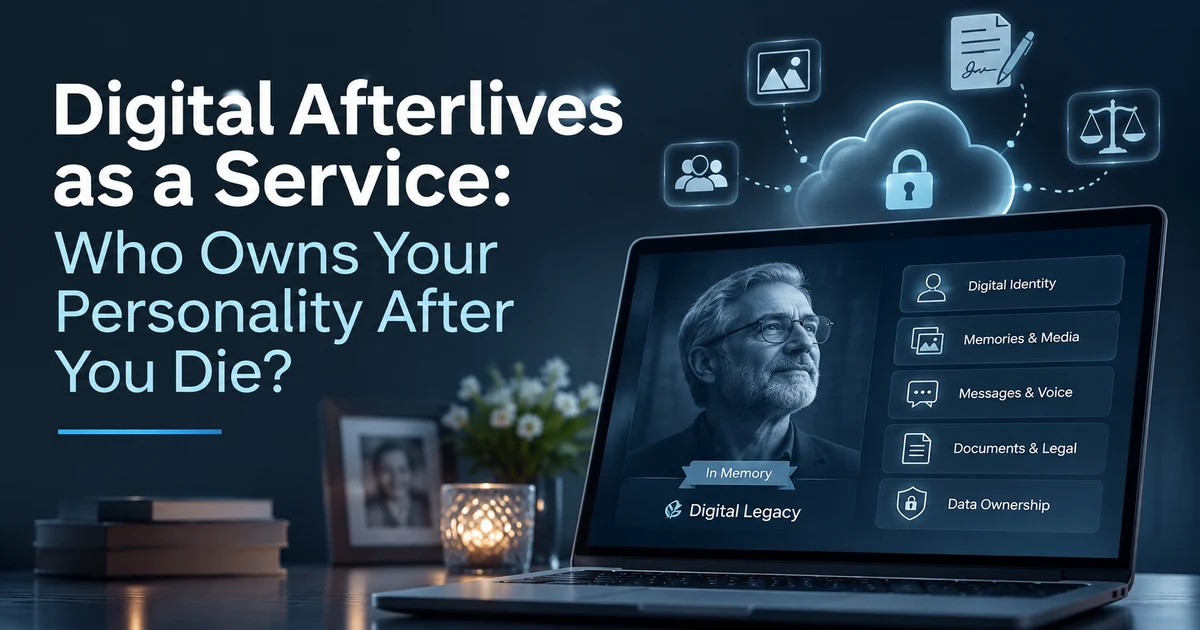
Imagine receiving a message from someone who passed away years ago. Their voice sounds familiar, their humor feels unchanged, and their responses resemble the conversations you remember having together.
You know the person is gone, yet the interaction feels surprisingly real.
Artificial intelligence is making this possibility more than a science fiction concept. Digital afterlife services can use recordings, photographs, personal stories, and other information to create interactive representations of people who are no longer alive.
Some systems allow families to hear recorded memories. Others use generative AI to simulate conversations based on a person’s digital history.
These technologies promise to preserve memories and create new ways for families to connect with the past.
But they introduce a complicated question: Who owns a person’s digital personality after death?
Could relatives decide how someone is represented? Could technology companies continue generating new conversations using that person’s identity? And what happens if a digital replica begins expressing opinions its human counterpart never held?
As artificial intelligence becomes capable of recreating increasingly convincing personalities, society may need to reconsider what it means to leave behind a digital legacy.
What Is a Digital Afterlife Service?
A digital afterlife service uses technology to preserve or simulate aspects of a person’s identity after death.
These services vary considerably in how they operate.
Some preserve recorded stories, photographs, and voice messages that families can access later.
Others use artificial intelligence to generate conversational responses resembling how someone might have spoken.
More advanced concepts involve digital avatars that combine synthetic voices, realistic appearances, and interactive personalities.
These systems are sometimes called griefbots, deadbots, or postmortem avatars.
Companies such as HereAfter AI and StoryFile have explored interactive ways of preserving personal stories and memories, although their technologies and services differ.
A fundamental distinction exists between replaying authentic recordings and generating entirely new responses.
A recorded memory preserves something a person actually said. A generative AI replica creates new content based on patterns learned from available information.
That difference becomes important when deciding who should control a digital identity.
Can Artificial Intelligence Truly Recreate Someone’s Personality?
AI can imitate certain characteristics of human communication.
A system trained or provided with enough relevant information may reproduce familiar phrases, recurring interests, communication styles, and biographical details.
Voice synthesis can also create speech resembling a particular person, while image-generation technology can produce realistic visual representations.
However, these capabilities do not amount to recreating human consciousness.
An AI replica does not possess the original person’s complete memories, subjective experiences, or independent identity.
Instead, it generates responses based on its underlying model, supplied information, and operating instructions.
This creates an important limitation.
A digital representation might sound convincing while inventing details the real person never knew or believed.
The more naturally an avatar communicates, the easier it may become for users to overlook the difference between authentic memories and machine-generated statements.
Who Legally Owns a Personality After Death?
There is no universal legal rule establishing that a person’s entire personality becomes property owned by someone else after death.
The legal situation involves several separate categories of rights.
These can include rights associated with personal information, photographs, creative works, commercial identity, and digital accounts.
For example, copyright may protect original writings, photographs, or recordings.
Rights involving someone’s name, image, voice, or likeness may receive separate protection under applicable publicity or personality laws.
Access to social media accounts and stored messages may depend on platform agreements and digital estate laws.
These protections do not necessarily belong to the same person or organization.
An estate might control certain commercial rights while a technology company holds a license to use particular recordings.
Meanwhile, a family member could own photographs without possessing unrestricted authority to create an AI replica.
Consequently, owning someone’s digital files does not automatically mean owning their personality.
Could Family Members Create an AI Replica Without Permission?
One difficult ethical question concerns whether relatives should be allowed to recreate someone who never agreed to become an AI personality.
Imagine an adult child using old emails, voice messages, and family videos to create a conversational version of a deceased parent.
The motivation may be loving and sincere.
However, the parent might have valued privacy or objected to having their identity digitally simulated.
Because they are no longer alive, they cannot approve the representation or challenge its behavior.
Legal requirements vary, and some uses may involve protected likenesses, copyrighted materials, or contractual restrictions.
Yet legality does not resolve every ethical concern.
Researchers studying digital afterlife services have emphasized the importance of consent from both the person being represented and those expected to interact with the simulation.
Family relationships should not automatically override the wishes someone expressed while alive.
Should People Give Consent Before Their Digital Personality Is Created?
Advance consent could become one of the most important safeguards in digital afterlife technology.
People may eventually be asked whether they want their voices, memories, and communication styles preserved for future AI interaction.
However, meaningful consent requires more than accepting a general privacy policy.
Someone should understand what the service will create and how the replica may behave.
For example, agreeing to preserve recorded family stories is different from authorizing a chatbot to generate new conversations indefinitely.
Consent should also address whether the representation can be used commercially.
A person might welcome private conversations with family members while opposing public advertising or entertainment appearances.
Ideally, individuals should be able to change their preferences while alive.
They should also have a meaningful option to prohibit digital recreation entirely.
Could Technology Companies Own Your Digital Replica?
Technology companies may control the software and infrastructure required to operate AI-generated personalities.
Their contracts may grant them certain rights to process uploaded information, generate content, or maintain a service.
However, operating a replica does not automatically establish ownership of every underlying personal or intellectual property right.
The distinction between owning technology and controlling identity is important.
A company may own proprietary software while users or other rights holders retain rights in particular uploaded materials.
Nevertheless, contractual terms could give providers considerable practical influence.
They may control account access, available features, data retention, and the technical ability to operate the replica.
If families cannot transfer the underlying records or generated content, they may become dependent on a single company.
This creates the possibility of a person’s digital identity being governed more by commercial service arrangements than by their original wishes.
Could Digital Likeness Laws Protect People After Death?
Some jurisdictions already recognize legal protections for particular uses of deceased individuals’ identities.
In 2024, California enacted legislation addressing unauthorized digital replicas of deceased performers.
The law expanded protections involving certain uses of simulated voices and likenesses in expressive works, subject to relevant exceptions.
California also recognizes certain postmortem publicity rights under specified conditions.
However, these protections do not amount to a universal ownership right over every aspect of someone’s personality.
They also differ from laws governing private messages, family photographs, or access to digital accounts.
In the European Union, the General Data Protection Regulation does not generally apply to personal data belonging to deceased people, although member states may establish their own rules.
The legal landscape remains fragmented.
Future legislation may need to address digital replicas more directly rather than relying entirely on existing categories of intellectual property and privacy law.
What Happens to Private Conversations Used to Build Digital Personalities?
A person’s digital history often contains information about other people.
Emails, private messages, photographs, and voice recordings may reveal sensitive details about friends, relatives, coworkers, and romantic partners.
Using these materials to create an AI personality can therefore affect individuals who never consented to the service.
Imagine a deceased person’s private messages being uploaded into a digital replica.
The system might later reveal confidential information during a conversation with another family member.
It could also generate inaccurate statements about people mentioned in the original records.
This creates a distinction between preserving personal memories and exposing someone else’s private information.
Data involving living individuals may remain protected by applicable privacy laws even when the original account holder has died.
Digital afterlife services need safeguards that protect the privacy of everyone represented in the source material.
Could an AI Replica Change Someone’s Personality Over Time?
Generative AI systems can produce new responses that are not directly copied from their training materials.
This means a digital replica might gradually appear different from the person it represents.
For example, it could express opinions about technologies invented after the person’s death.
It might answer political, financial, or family questions in ways the original individual never would have considered.
Software updates could also change conversational behavior.
A future version might sound more confident, emotionally expressive, or agreeable than earlier versions.
These developments raise questions about authenticity.
If the replica begins expressing unfamiliar beliefs, is it still an accurate representation of the deceased?
A responsible service should distinguish verified historical information from newly generated interpretations.
The system should never present invented opinions as confirmed statements from someone who can no longer speak for themselves.
Who Should Control What a Digital Replica Is Allowed to Say?
Control over generated conversations may become one of the most controversial aspects of digital afterlife services.
A deceased parent might appear to offer advice about marriage, investments, or family disagreements.
An AI-generated response could feel unusually authoritative because it resembles someone the user trusted.
However, the original person did not create or approve that specific advice.
Allowing a replica to make consequential decisions could therefore create confusion.
A sensible system might restrict certain categories of interaction.
For example, it could avoid presenting generated financial instructions, legal decisions, or medical recommendations as the deceased person’s genuine wishes.
Families should also understand that the replica cannot create new legally binding instructions on behalf of the person it represents.
A digital personality may preserve memories, but it should not become an unquestionable authority over the living.
Could Digital Afterlives Become Subscription Services?
Maintaining AI replicas requires computing infrastructure, storage, software maintenance, and potentially ongoing customer support.
Companies may therefore offer subscription-based access.
A family could pay a monthly or annual fee to continue interacting with a loved one’s digital personality.
This creates an unusual commercial relationship.
Unlike an entertainment subscription, the service may carry significant emotional meaning.
Someone could become accustomed to speaking with a digital representation and feel distressed when payment problems interrupt access.
Future businesses might also introduce premium features, such as more realistic voices, personalized avatars, or extended conversations.
Such offerings raise concerns about commercializing grief.
The challenge is ensuring that companies provide transparent pricing without exploiting emotional attachment.
Families should understand the financial commitments involved before relying on a service for long-term remembrance.
What Happens When a Digital Afterlife Company Shuts Down?
No technology company can guarantee that its services will operate forever.
Businesses may close, change ownership, discontinue products, or replace underlying technology.
If a digital afterlife platform shuts down, families could lose access to years of preserved information or generated conversations.
This possibility is particularly concerning when the service is advertised as a permanent digital legacy.
Long-term continuity requires practical planning.
Providers could offer options to export original recordings, photographs, written memories, and other information in usable formats.
They might also establish clear procedures for account closure and data deletion.
However, exporting source materials does not necessarily preserve the complete functionality of a proprietary AI personality.
A digital afterlife service should explain this limitation rather than promising technological immortality.
Could Speaking With a Digital Version of Someone Help With Grief?
Digital afterlife technologies may offer comfort to some grieving individuals.
Hearing a familiar voice or revisiting personal stories could encourage remembrance and emotional reflection.
Interactive archives might also allow younger family members to learn about relatives they never met.
However, the psychological effects of extended conversations with AI-generated versions of deceased people remain insufficiently established.
Some individuals may find these interactions reassuring.
Others could experience distress, confusion, or difficulty adjusting to the permanence of a loss.
Researchers from the University of Cambridge have raised concerns about unwanted interactions with digital replicas and the need for sensitive ways to end those relationships.
The effects will likely depend on individual circumstances, expectations, and how the technology is designed.
Digital simulations should not be presented as established treatments for grief.
Could People Refuse to Interact With a Digital Relative?
A deceased person’s decision to create an AI replica should not automatically obligate relatives to interact with it.
Imagine a parent arranging for an automated digital personality to send messages to their children after death.
One child may appreciate the experience, while another may find it upsetting.
The second person should not feel forced to participate.
This highlights the need for consent from recipients as well as creators.
Responsible platforms should allow people to decline invitations, stop messages, or permanently end interactions.
Researchers have also suggested that services need respectful procedures for retiring digital replicas.
Ending access should not be framed as abandoning the deceased.
People must remain free to remember loved ones in ways that feel appropriate to them.
Could Companies Use Deceased Personalities for Advertising?
Digital replicas could become commercially valuable because they reproduce recognizable identities.
A famous person’s simulated voice might promote products long after their death.
A fictionalized version of an ordinary individual could also appear in advertisements or promotional content.
Commercial use creates additional legal and ethical questions.
Applicable publicity rights, copyright protections, and contractual restrictions may limit certain activities.
However, legal protections vary.
A family member controlling a commercial right might authorize an appearance that other relatives consider inappropriate.
Companies should also avoid presenting generated endorsements as authentic personal recommendations.
A deceased individual cannot evaluate new products or independently approve new advertising claims.
Commercial representations should clearly disclose their synthetic nature and comply with applicable requirements.
Should Digital Personalities Be Included in Estate Planning?
Digital estate planning traditionally addresses online accounts, electronic records, and access to digital property.
AI-generated personalities introduce additional questions.
People may want to specify whether they permit a digital replica to be created after their death.
They could also identify which information may be used, who may access the replica, and whether commercial uses are prohibited.
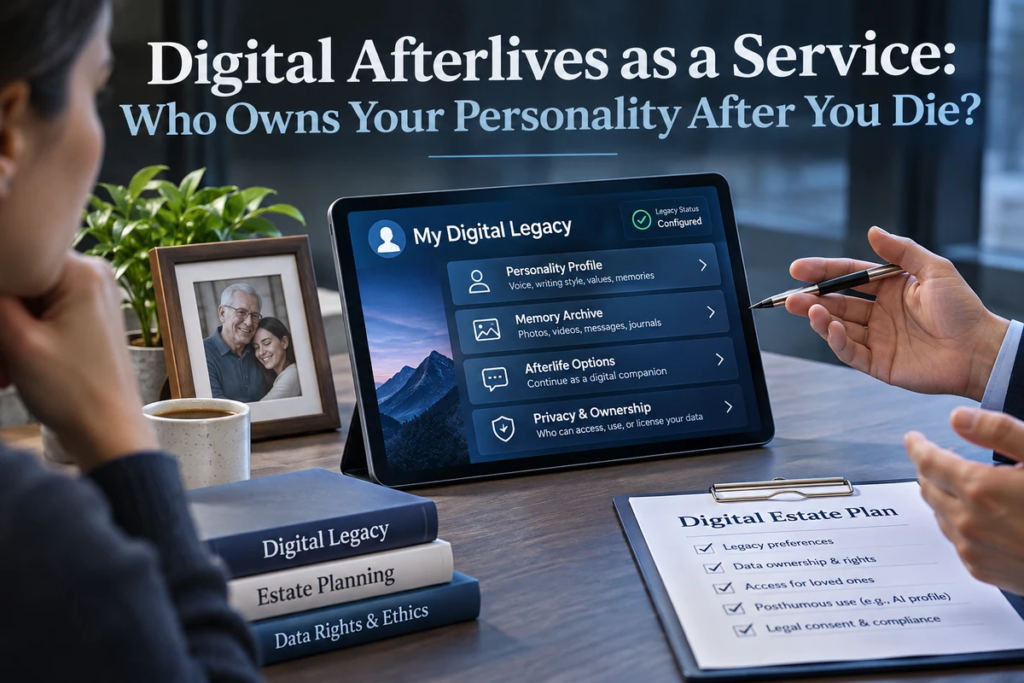
Potential instructions might cover:
- Consent: Whether an AI representation may be created at all.
- Authorized data: Which recordings, photographs, and messages may be used.
- Access: Who may interact with the digital personality.
- Restrictions: Whether public appearances or commercial uses are permitted.
- Duration: How long the service may remain active.
- Deletion: When and how the data should be permanently removed.
- Administration: Who may make permitted decisions about the service.
However, including these preferences in a will does not automatically guarantee that every instruction will be legally enforceable.
Estate planning laws, platform agreements, and intellectual property rights vary.
Legal advice may be necessary when digital identity rights are especially important.
Could Future Laws Recognize a Right to Digital Death?
The concept of a right to digital death involves allowing individuals to prevent unwanted digital recreation after they die.
Under this approach, a person could express a legally meaningful preference not to have their identity simulated.
Researchers and legal scholars have argued that existing protections may not fully address the distinctive problems created by AI resurrection technologies.
Future rules might establish stronger consent requirements, restrictions on commercial use, or rights to have certain digital representations removed.
However, such proposals create difficult questions.
Who would enforce a deceased person’s wishes?
What happens when different family members disagree?
Could a digital replica be prohibited even when its source materials were lawfully obtained?
A comprehensive legal framework would need to balance personal autonomy, freedom of expression, intellectual property rights, family interests, and public access to historical information.
People Also Ask About Digital Afterlives and AI Personality Ownership
Who owns an AI version of someone after they die?
There is no universal rule granting ownership of a deceased person’s entire AI personality. Rights may involve copyrighted materials, commercial likeness protections, digital accounts, and contractual agreements. Different individuals or organizations may control different aspects of a digital replica.
Can family members legally create an AI chatbot of someone who died?
The answer depends on the jurisdiction, source materials, intended use, and applicable rights. Family relationships do not automatically provide unrestricted permission to use a deceased person’s identity. Commercial uses and copyrighted materials may involve additional legal requirements.
Can someone prevent their personality from being recreated after death?
People can express their wishes through estate planning documents, service preferences, and certain contractual arrangements. However, legal enforceability varies. There is no universal law guaranteeing complete control over every possible AI recreation after death.
Can AI recreate the real personality of a deceased person?
AI can imitate communication patterns, voices, and biographical details using available information. However, it does not recreate the person’s consciousness or guarantee accurate responses. Generated conversations may contain invented memories, opinions, or statements the deceased never made.
Can an AI version of a deceased person continue learning?
Some AI systems can incorporate additional information or retain conversational context, depending on their design. However, this does not mean the deceased person’s consciousness continues developing. Any new responses are generated by software, not by the original individual.
What happens to a digital replica when its subscription ends?
Access may be restricted or discontinued depending on the provider’s policies. Some services may allow users to export original recordings or data, while others may not preserve the interactive functionality. Families should review termination, retention, and export policies before subscribing.
Are conversations with AI versions of deceased people safe for grieving families?
The psychological effects remain an active area of research. Some people may find digital interactions comforting, while others may experience distress or confusion. These services are not established grief treatments, and users should have meaningful control over whether and how they interact.
Can a deceased person’s AI replica be used in advertising?
Certain uses may be restricted by publicity rights, intellectual property laws, contractual obligations, or other legal requirements. Protections vary by jurisdiction and context. Commercial use should not misleadingly suggest that the deceased personally approved or experienced a product.
When Your Digital Identity Outlives You
Human beings have always found ways to preserve memories of people who have died.
Photographs, letters, recordings, and family stories allow future generations to learn about individuals they never personally knew.
Artificial intelligence introduces something fundamentally different.
Instead of preserving only what someone actually said or did, technology can generate new conversations and experiences that imitate how the person might have behaved.
This creates opportunities for remembrance, education, and personal connection.
However, it also challenges how society understands identity, ownership, consent, and the boundary between authentic memories and artificial representations.
A digital replica may resemble someone closely, but it remains a technological simulation rather than the continuation of that person’s consciousness.
The future of digital afterlife services will therefore depend on more than creating convincing personalities.
It will require clear rules about consent, responsible data handling, commercial use, family access, and the right to refuse digital recreation.
Most importantly, individuals should have meaningful opportunities to decide how their identities may be represented after death.
Because the question is not simply whether technology can preserve our personalities indefinitely. It is whether we should retain the right to decide what happens to our digital selves when we are no longer here to speak for them.
Leave a Reply